
The United States Pharmacopeia (USP) classifies HPLC columns using standardized “L” codes based on stationary‑phase chemistry and particle characteristics to support consistency in compendial methods. Because USP classifications are intentionally broad, multiple columns may meet the same L‑code while exhibiting different selectivity and performance.
This listing maps Cogent™ HPLC columns to their corresponding USP classifications as an aid for scientists working with USP or validated methods. Column selection should always be confirmed through appropriate system suitability testing and method verification.
Many methods currently published as USP monographs utilize the USP Classification of HPLC Columns. This listing of Cogent Columns by USP Classification is published as an aid to scientists using these monographs.
L1 C18 (ODS) bonded to Dp silica ranging from 1.8µ-10µ.

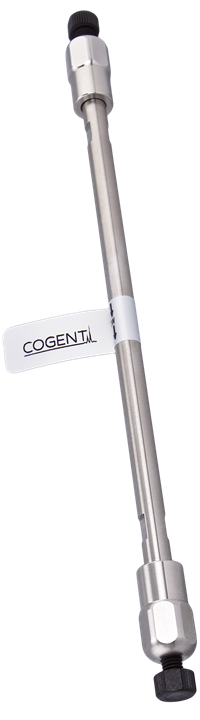
L3 Silica, porous particles, un-bonded, Dp 1.8µ-10µ.
Unbonded porous silica phases typically used for normal‑phase separations and adsorption‑based mechanisms; selectivity is highly sensitive to surface activity and mobile‑phase composition.
L7 Octyl (C8) bonded to Silica, 1.8µ-10µ.
Moderately hydrophobic octyl‑bonded silica phases offering reduced retention compared to C18; often selected for faster elution or analytes sensitive to excessive hydrophobic interaction.
L8 Aminopropyl (NH2) bonded to Dp silica ranging from 1.8µ-10µ.
Aminopropyl‑bonded silica phases commonly used for normal‑phase, carbohydrate, and polar compound separations; retention behavior may vary with buffer strength and pH.
L10 Cyano (CN) groups bonded to Dp silica ranging from 1.8µ-10µ.
Cyano‑bonded phases capable of operating in reversed‑phase or normal‑phase conditions depending on mobile‑phase composition; selectivity and polarity behavior vary by surface chemistry.
L11 Phenyl (C13H25) groups bonded to Dp silica ranging from 1.8µ-10µ.
Phenyl‑bonded silica phases providing π‑π interaction selectivity in addition to hydrophobic retention; often selected for aromatic or structurally similar analytes.
- Cogent Phenyl Hydride™
- Cogent Biphenyl™
- Cogent RP™ Phenyl
- Cogent MS-MicroBee™ Phenyl
- Cogent RP™ Phenyl Hexyl
Low‑hydrophobicity butyl‑bonded phases typically used for biomolecules or large analytes where strong hydrophobic retention is undesirable.
L43 PentaFluoroPhenyl (PFP). Dp ranging from 1.8µ to 10µSpecialty phenyl phases incorporating fluorinated functionality to provide enhanced selectivity for halogenated, polarizable, or structurally similar compounds.
L62 C30 silane bonded phase on a fully porous spherical silica, 1.8 to 10µm in diameter.Long‑chain alkyl phases designed for enhanced shape recognition and retention of highly hydrophobic analytes, such as carotenoids and lipophilic compounds.
L85 An Alkyl chain longer than C8 and including weak cation-exchange, 1.0 to 50µm in diameter.Columns combining hydrophobic alkyl retention with weak cation‑exchange functionality; selectivity is influenced by both ionic interactions and alkyl chain length.
USP Disclaimer: